Top global emerging market mixed bond funds
Introduction
In an economic context marked by rate cuts orchestrated by central banks, a moderate but stable rise in the dollar, and a historically low default risk thanks to a stabilized global economy, Global Emerging Market Mixed Bond Funds present a strategic investment opportunity. The progressive improvement of the Chinese economy, supported by its quantitative easing program, further strengthens the attractiveness of this category.
With over 5,000 referenced fund shares, this category offers a wide range of options. Among these funds, 217 euro-denominated shares are accessible through life insurance and PER contracts available in France. Thanks to their potential return of up to 6%, combined with low volatility, these funds appeal to both cautious investors and those seeking performance.
The EnvestBoard tool allows you to select the best active and passive funds in this category.
By relying on qualitative and quantitative analysis of performance & risks, and ESG criteria, EnvestBoard provides you with the means to optimize your choices to take advantage of this promising asset class. Discover in this analysis the funds that stand out for their management and unique opportunities.
Performance over 3 years (from 30/11/2021 to 29/11/2024)
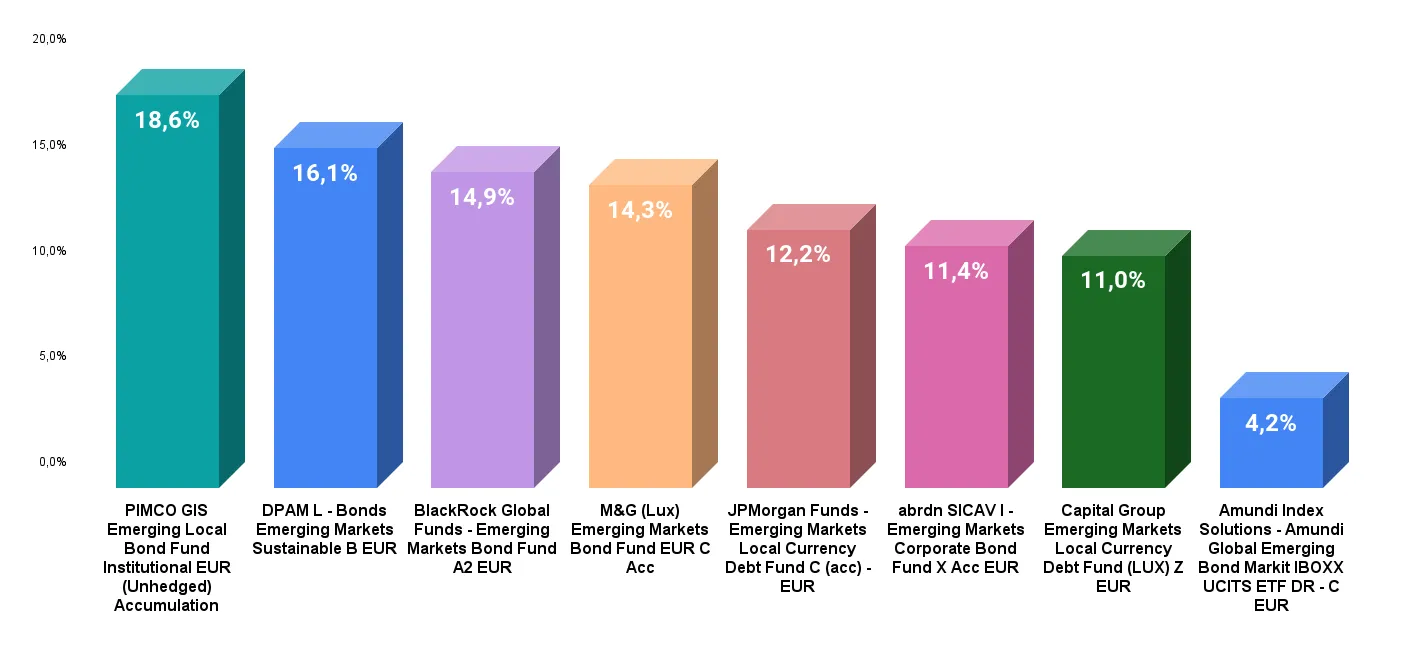
Analysis of active and passive funds
1. PIMCO GIS Emerging Local Bond Fund
- Investment strategy: Invests primarily in local currency bonds from emerging markets. The objective is to benefit from economic growth and geographic diversification while actively managing currency risk.
- Key features: An active approach combining global and local macroeconomic research with fundamental analysis to identify optimal investment opportunities.
- ESG: Classified as SFDR Article 8, this fund integrates ESG criteria into its selection process, but this is not its primary objective.
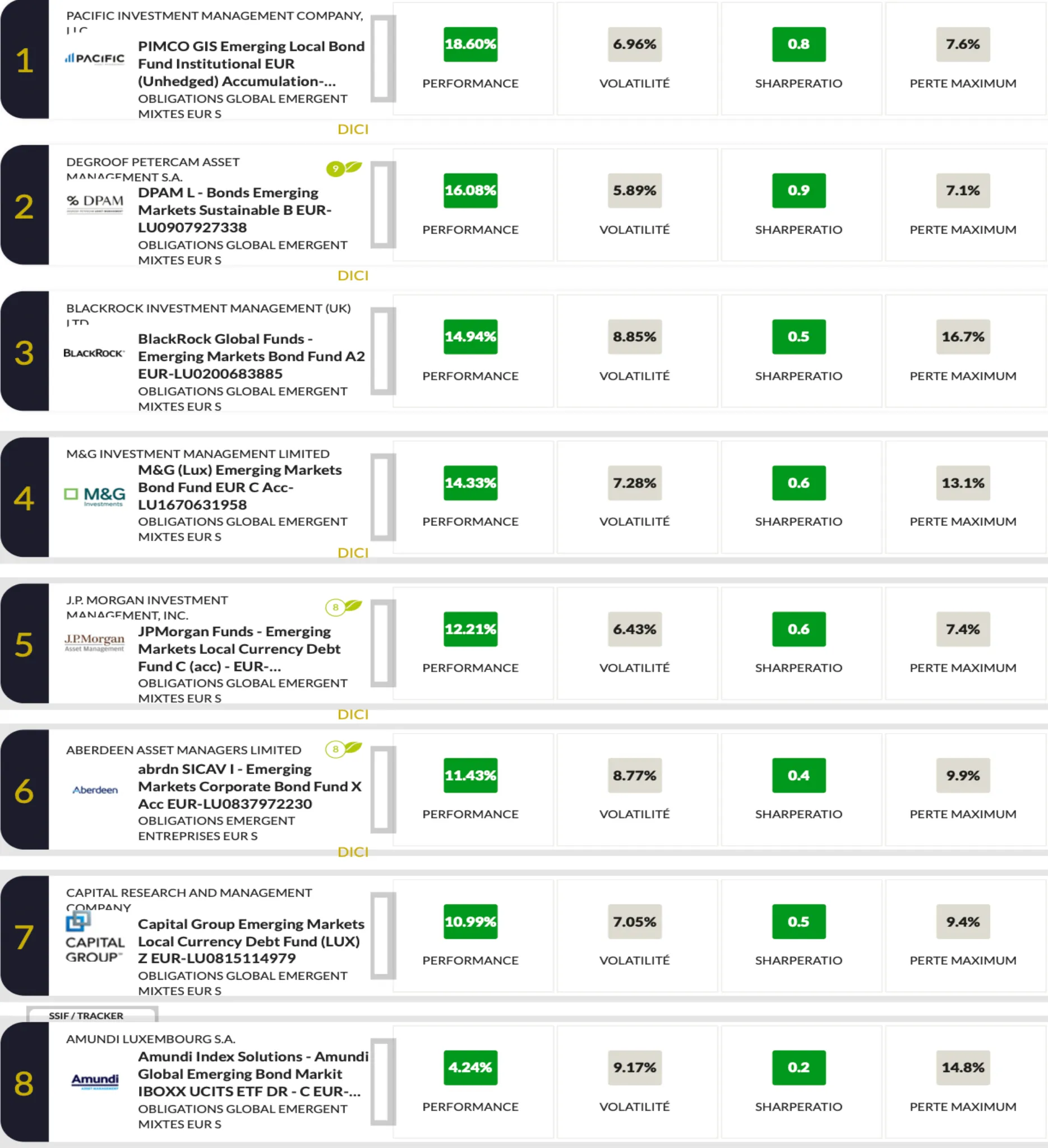
- 3-year Quantitative Analysis: The fund stands out with an annualized performance of 5.82%, combined with a volatility of 6.96%. Its Sharpe ratio of 0.8, among the highest, reflects strong risk-adjusted management. With a maximum drawdown of 7.6%, it outperforms the majority of its peers and the tracker.
- EnvestBoard Link: Access the fund
- Managers: Michael Gomez, Lupin Rahman
- Management Company: PIMCO
- Commercial Contact: Eleni SIFAKIS
2. DPAM L Bonds Emerging Markets Sustainable
- Investment strategy: Invests in sovereign and quasi-sovereign bonds from emerging markets, favoring issuers with strong sustainability profiles.
- Key features: A strong emphasis on sustainable bonds and ESG criteria to improve portfolio quality while maximizing risk-adjusted returns.
- ESG: Classified as SFDR Article 8. The fund emphasizes green and social bonds, reflecting its commitment to sustainable finance.
- 3-year Quantitative Analysis: This sustainable fund shows a solid annualized performance of 5.60% with one of the lowest volatilities at 5.89%. The Sharpe ratio reaches nearly 1, indicating quality management. The maximum drawdown of 7% demonstrates robustness during volatile periods, outperforming the Amundi tracker. VaR data shows controlled exposure to market fluctuations.
- EnvestBoard Link: Access the fund
- Managers: Peter De Coensel
- Management Company: Degroof Petercam Asset Management (DPAM)
3. BlackRock Global Funds Emerging Markets Bond Fund
- Investment strategy: The fund focuses on emerging market bonds issued by governments and corporations, primarily denominated in hard currencies (USD, EUR). The management adopts an active strategy, combining in-depth macroeconomic analysis and rigorous security selection.
- Key features: The approach is distinguished by active and dynamic management, integrating derivative instruments to effectively manage interest rate and currency risks. The portfolio seeks to capture the higher returns offered by emerging markets while maintaining optimal liquidity and diversification.
- ESG: Not specified in the provided documents. BlackRock generally emphasizes ESG integration in its investment processes, although this is not mentioned for this particular fund.
- 3-year Quantitative Analysis: With an annualized performance of 4.72% and a volatility of 8.85%, this fund displays a respectable Sharpe ratio of 0.5. Although its maximum drawdown of 16.7% is higher than some active funds, it exceeds the tracker in terms of risk-adjusted return.
- EnvestBoard Link: Access the fund
- Managers: NA in the documents.
- Management Company: BlackRock
- Commercial Contacts: Charlotte GROSSEAU, Ivana DAVAU, Victoire ROCHE
4. M&G (Lux) Emerging Markets Bond Fund
- Investment strategy: Builds a diversified portfolio of emerging market bonds, including sovereign and corporate debt, while seeking a balance between risk and return.
- Key features: Uses an active and flexible approach to adapt to macroeconomic and geopolitical changes.
- ESG: Classified as SFDR Article 8. Integrates ESG criteria in asset selection to meet the expectations of sustainability-minded investors.
- 3-year Quantitative Analysis: With an annualized performance of 4.54% and a volatility of 7.28%, this fund positions itself as a balanced choice. The Sharpe ratio of 0.6 and a maximum drawdown of 13.1% reflect effective active management. Compared to the tracker, this fund combines better risk-adjusted performance and reduced volatility.
- EnvestBoard Link: Access the fund
- Managers: Claudia Calich
- Management Company: M&G Investments
- Commercial Contacts: Kelly HEBERT, Adrien BARBANCHON
5. JPMorgan Funds – Emerging Markets Local Currency Debt Fund
- Investment strategy: Aims to maximize total return by investing in local bonds from emerging markets while optimizing currency risk.
- Key features: An active approach based on in-depth analysis of country fundamentals and rigorous risk management.
- ESG: Classified as SFDR Article 8. The fund integrates ESG factors into its investment process without focusing exclusively on these criteria.
- 3-year Quantitative Analysis: With an annualized performance of 3.89%, this fund combines a contained volatility of 6.43% and a Sharpe ratio of 0.6. Its maximum drawdown of 7.4% is significantly lower than the tracker’s, reinforcing its appeal for cautious investors.
- EnvestBoard Link: Access the fund
- Manager: Pierre-Yves Bareau
- Management Company: J.P. Morgan Asset Management
- Commercial Contact: Louis-Charles Nerot
6. Abrdn SICAV I – Emerging Markets Corporate Bond Fund
- Investment strategy: Invests in corporate bonds from emerging markets, with an emphasis on high-growth companies with attractive credit profiles.
- Key features: Active approach aimed at outperforming the JP Morgan CEMBI Broad Diversified Index through rigorous security selection.
- ESG: Classified as SFDR Article 8. Integrates ESG criteria in the selection process, with strict exclusions for controversial sectors.
- 3-year Quantitative Analysis: With an annualized performance of 3.65%, this fund displays a relatively low volatility of 8.77%, highlighting prudent risk management. However, its Sharpe ratio of 0.4 remains moderate, reflecting relatively stable risk-adjusted performance. Compared to the Amundi Global Emerging Bond tracker, it offers better maximum drawdown control, limited to 9.9%, versus 14.8% for the tracker. The fund shows a rapid loss recovery with 29.2 weeks.
- EnvestBoard Link: Access the fund
- Managers: Global Emerging Market Debt Team
- Management Company: abrdn
- Commercial Contact: Christine Duboÿs
7. Capital Group Emerging Markets Local Currency Debt Fund (Lux)
- Investment strategy: The fund aims to generate an attractive return by investing in bonds issued by governments and corporations of emerging markets, denominated in their local currencies. The approach relies on macroeconomic and fundamental analysis to identify high-potential opportunities across different regions.
- Key features: Active management focused on geographic and sector diversification, aiming to minimize currency risk while optimizing returns. Particular importance is given to the assessment of credit quality and issuer sustainability.
- ESG: Not specified in the provided documents. ESG principles may be integrated within Capital Group’s overall management strategy, but do not constitute an explicit criterion for this fund.
- 3-year Quantitative Analysis: This fund presents a moderate annualized performance of 3.52%, combined with a low volatility of 7.05%. The Sharpe ratio of 0.6 reflects good risk-adjusted management. With a maximum drawdown of 9.4%, it clearly outperforms the tracker in terms of robustness during correction phases.
- EnvestBoard Link: Access the fund
- Managers: NA in the documents.
- Management Company: Capital Group
8. Amundi Global Emerging Bond Markit iBoxx UCITS ETF DR
- Investment strategy: The fund aims to replicate the performance of the Markit iBoxx USD Liquid Emerging Markets Sovereigns Mid Price TCA index. This index tracks sovereign bonds issued by emerging market governments, denominated in US dollars. The management uses direct replication, combining physical securities and derivative instruments if necessary.
- Key features: The strategy relies on rigorous passive management with minimal tracking error through sampled replication. The emphasis is on liquidity and security diversity to minimize costs while ensuring maximum proximity to the index performance.
- ESG: Not specified. However, the underlying index may include general liquidity and governance criteria for sovereign issuers.
- 3-year Quantitative Analysis: With a limited annualized performance of 1.39%, this tracker displays a volatility of 9.17%, the highest among the funds studied. Its Sharpe ratio of 0.2 is also the lowest, highlighting inferior risk-adjusted performance. The maximum drawdown of 14.8% highlights its increased sensitivity to market fluctuations.
- EnvestBoard Link: Access the fund
- Managers: Stéphanie Pless (Head of Fixed Income Index Management) Fadil Hannane (Lead Manager) Fabrice Degni Yace (Deputy Manager)
- Management Company: Amundi Asset Management
Risk indicators (EUR shares):
Top 7 active funds compared to the Amundi Global Emerging Bond Tracker (3 years: 30/11/2021 to 29/11/2024)
EnvestBoard Rating – 3-year Outperformance
Each month, funds within the same category are rated based on their 3-year outperformance relative to the category average.
- 5 stars : Top 10% of the best performing funds.
- 4 stars : Next 22.5%.
- 3 stars : Next 35%.
- 2 stars : Next 22.5%.
- 1 star : Bottom 10% of the least performing funds.
Glossary
Alpha: Measure of a fund’s performance relative to a benchmark adjusted for market risk. A positive alpha indicates that the fund has outperformed its benchmark through active management.
Beta: Indicator that measures a fund’s sensitivity to variations in its benchmark index. A beta greater than 1 means the fund is more volatile than the market.
VaR (Value at Risk): Statistical measure that estimates the maximum potential loss of a portfolio over a given period, at a specified confidence level. For example, a 95% VaR means that the loss should not exceed this amount in 95% of cases.
Volatility: Measure of the variation in the return of an asset or fund over time. High volatility indicates increased risk, as returns fluctuate more.
Sharpe Ratio: Indicator that measures a fund’s excess return relative to a risk-free asset (such as government bonds), adjusted for its volatility. A high Sharpe ratio reflects good risk management for the return achieved.
Maximum Drawdown: The largest loss recorded by a fund over a given period. This indicates the level of extreme risk to which the fund may be exposed.
ESG (Environmental, Social and Governance): Extra-financial criteria that evaluate a company’s commitment to sustainability and social responsibility.
Annualized Performance: Average annual growth rate of investments over a given period, taking into account the cumulative effect.
Tracker (or ETF): Index fund listed on a stock exchange that tracks the performance of a specific index, such as the MSCI World or another benchmark index.
SFDR (Sustainable Finance Disclosure Regulation): European regulation that classifies funds according to their consideration of environmental, social and governance (ESG) factors. Articles 6, 8 and 9 define their degree of ESG criteria integration:
- Article 6: Does not take ESG criteria into account.
- Article 8: Promotes ESG criteria in the investment process.
- Article 9: Funds with the primary objective of a positive environmental or social impact.
About the author: Yufeng Xie
Yufeng Xie is the CEO and co-founder of EnvestBoard, an innovative investment decision-support platform. A graduate of ENSAE Paris (Institut Polytechnique de Paris) with a background in economics from the Sorbonne, he has nearly 20 years of experience in asset and wealth management. Yufeng has held prestigious positions as a product structuring researcher, algorithmic trader and fund manager at major European financial institutions.
Passionate about economic analysis, mathematics and artificial intelligence, he founded EnvestBoard to offer advanced analytical solutions, enabling investors to make optimized and informed portfolio allocation decisions.
Please note:
Past performance is not indicative of future results. The content above does not constitute investment advice. It is an objective analysis of financial information.
Past performance is not indicative of future results. Fees are included in the performance figures. The content above does not constitute investment advice. It is an objective analysis of financial information.