The Debt Ceiling: What Is It?
The debt ceiling is the maximum debt that the USA can accumulate. If it is exceeded without an agreement to raise it, the U.S. government could run out of funds, potentially triggering a global financial crisis.
Ongoing Negotiations: Between a Rock and a Hard Place
Negotiations to raise the ceiling are complex. On one side, Republicans, influenced by Trump, want to limit spending. On the other, Biden insists on funding essential projects. The stakes are high.
In this context, we can envision two scenarios.
Scenario 1: Bipartisan Agreement
The ideal scenario would be a bipartisan agreement to raise the debt ceiling. Democrats would make concessions on spending, while Republicans would accept a debt increase. This compromise would guarantee economic stability, and we would remain in the same market environment, namely a gradual disinflation with currently robust growth that is likely at best to weaken.
Market attention will remain focused on central bank actions and their impact on inflation and growth.
Scenario 2: Deadlock and Echoes of 2013
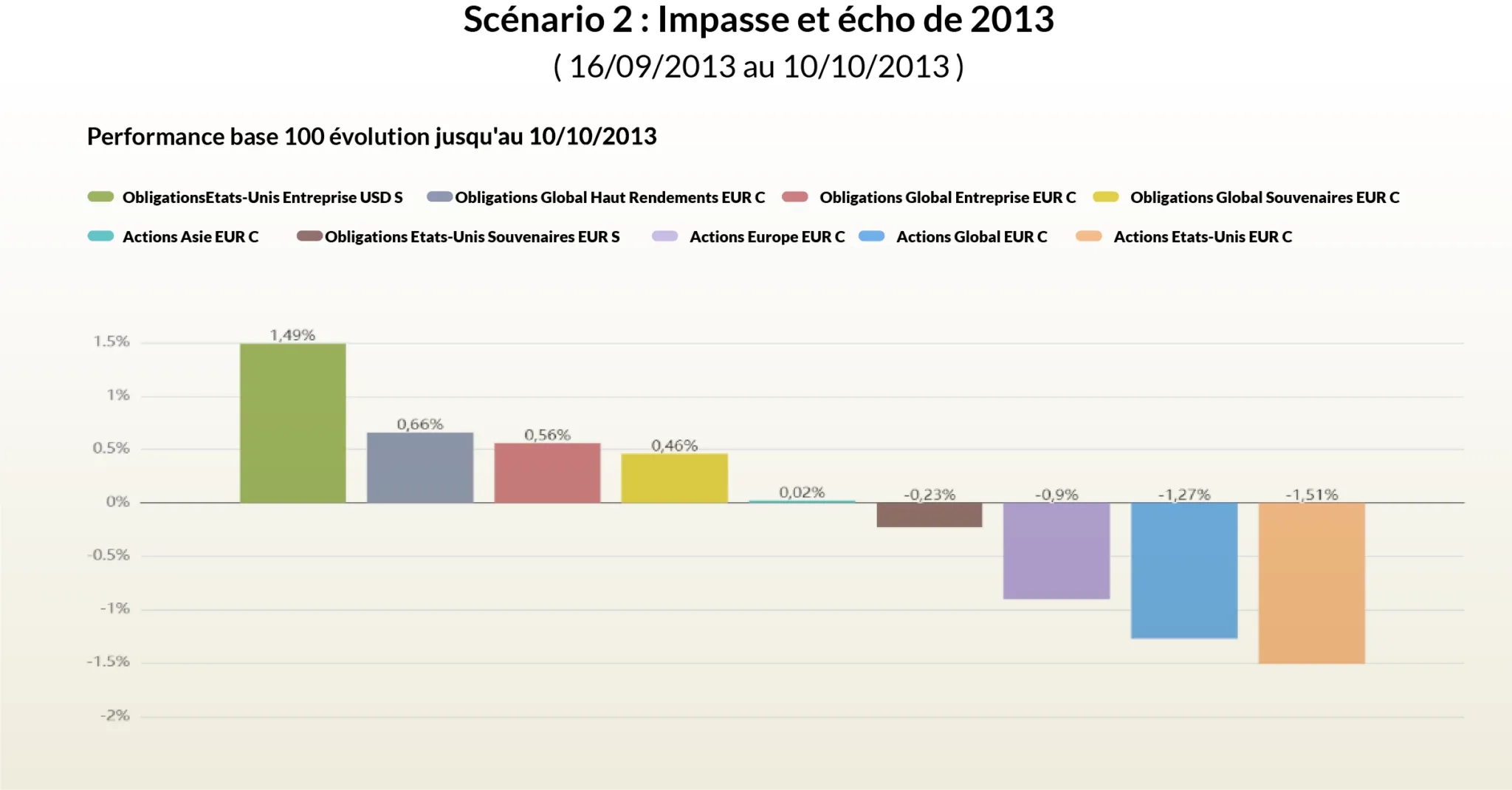
The second scenario, more alarming, envisions the failure of negotiations on raising the debt ceiling. This takes us back to 2013, when the United States came dangerously close to default.
At the time, the government was partially shut down for 16 days due to the political deadlock over raising the debt ceiling. Although catastrophe was narrowly avoided, this political crisis cast doubt on the financial stability of the United States and undermined investor confidence.
This scenario is unlikely but could have a negative impact on the market.
In 2013, equities and particularly U.S. stocks suffered. Conversely, U.S. corporate bonds saw a valuation surge, as investors viewed corporations as a safer haven over the state and its political tensions.
Past performance is not indicative of future results. Fees are included in performance figures. The content above does not constitute investment advice. It is an objective analysis of financial information.